
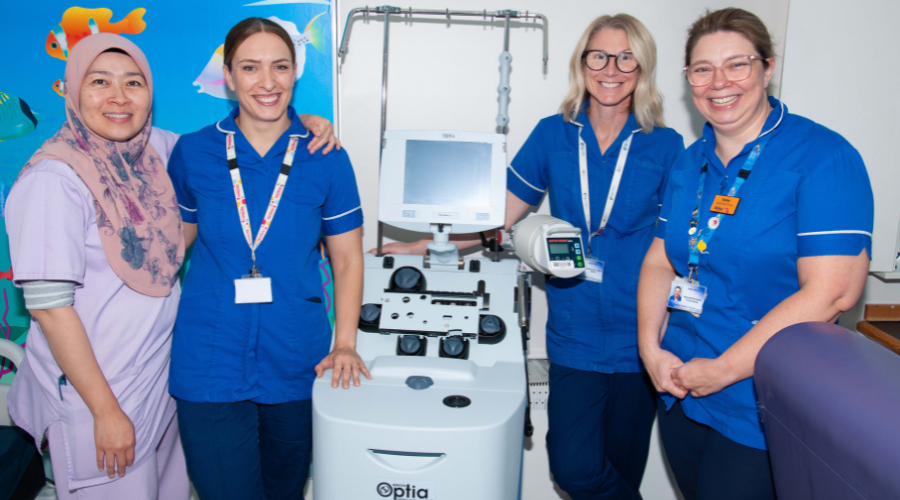
A new specialist service at the Leicester Children’s Hospital is providing access to life-changing treatment for children with sickle cell disease in the East Midlands for the first time.
Thanks to a successful bid for funding from NHS England, UHL has developed a paediatric red cell exchange service, improving care for children from Leicester, Leicestershire and Rutland, and the wider region.
Sickle cell is an inherited blood condition where red blood cells can become hard, sticky and sickle-shaped, causing severe pain, anaemia and potentially serious complications.
Red cell exchange treatment carefully removes sickle red blood cells and replaces them with healthy, donated red blood cells – reducing the amount of sickle haemoglobin in the patient’s blood, and helping to prevent complications.
Rejoice Makwebo, 16, from Glenfield, is one of the patients who is benefiting from the new service. She attends the LRI every six weeks for transfusions, which can take several hours at a time.
Rejoice’s sickle cell disease had proved manageable through medication for several years, but her condition suddenly deteriorated in 2025, and she experienced extreme pain. Several lengthy hospital stays were necessary, including emergency care, but she is now benefiting from red cell exchange treatment every six weeks and her health has significantly improved.
Rejoice said: “I am feeling less tired now, and much less pain. The treatment is making my life much easier. The nursing team at the LRI are really nice, and I want to thank them, as they always do so much to keep me occupied and distracted during the transfusions.
”The red cell exchange service is positively impacting my life, so I want to encourage everyone to please give blood if they can, as it can make such a big difference for people like me who need it.”
Establishing the service in Leicester was made possible thanks to NHS England funding to install a Spectra Optia apheresis and cell collection system at Ward 27, LRI.
Clinical Nurse Specialist, Rachael Hill, said: “For children who need it, red cell exchange can mean less pain, fewer complications and hospital admissions, and an improved quality of life. We are proud to provide this specialist treatment closer to home and make a real difference to children and their families.
“Our service relies on blood donors, and we particularly need more Black and ethnically diverse donors, as closely matched blood can be especially important for people living with sickle cell disease.”
To support people with sickle cell disease, everyone who can do so is encouraged to consider donating blood, particularly people of Black heritage. For more information on how to donate, and why more Black heritage blood donors are needed, visit the NHS Blood Donation website.