
A Leicestershire woman who has struggled to walk for two years because of severe pain in her leg is looking forward to getting back into her garden after becoming the first patient in the UK to undergo an innovative new vascular procedure.
A specialist team at University Hospitals of Leicester NHS Trust (UHL) has successfully used new technology to clear a blocked stent in the leg of patient Teresa O’Conner, restoring blood flow affected by Peripheral Artery Disease (PAD) and avoiding the need for major surgery.
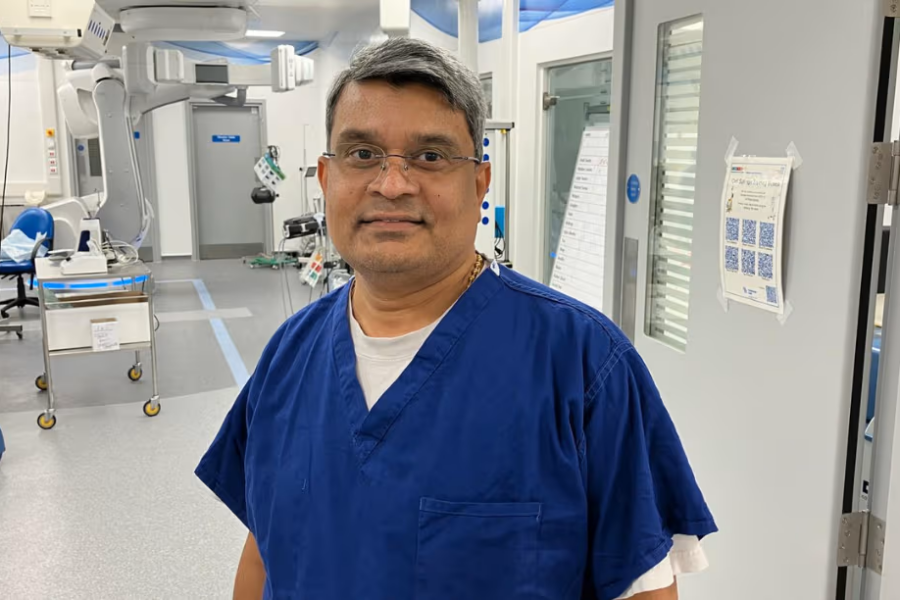
The procedure, which was carried out at the Glenfield Hospital, was led by Mr Badri Vijaynagar, Consultant Vascular and Endovascular Surgeon, using a device known as BYCROSS.
Inserted into the blood vessel using minimally invasive keyhole techniques, the device has a rotating tip which breaks down the material causing the blockage, while simultaneously removing the debris through an aspiration system.
For Teresa, from Cosby, the results were almost immediate.

The 58-year-old had experienced pain in her leg on and off for several years before having a stent inserted to improve the blood supply. Although this initially helped, the pain later returned when the stent itself became blocked. Over the last two years, the pain had become so debilitating that she struggled to walk on her own.
Teresa said: “When you can’t walk, it takes your life away. It’s awful and I felt like I had lost part of my identity.
“I am diabetic and have experienced pain in my leg on and off for a few years. I had a stent put in and things were better for a while, but then the pain returned, and they discovered it had become blocked.
“I am so grateful to the team for giving me the opportunity to have this new procedure. Everyone has been amazing and they explained everything so clearly to me. To be able to walk without my crutch the following day was incredible.
“I’m really looking forward to getting my independence back. I love my garden and, once I have fully recovered, I can’t wait to get back out there and start gardening again.”
Because BYCROSS can be delivered through keyhole surgery, patients suitable for the procedure can avoid the greater risks and longer recovery associated with major surgery such as a surgical bypass. It is also less invasive than open surgery and can offer patients a faster recovery and shorter hospital stay.
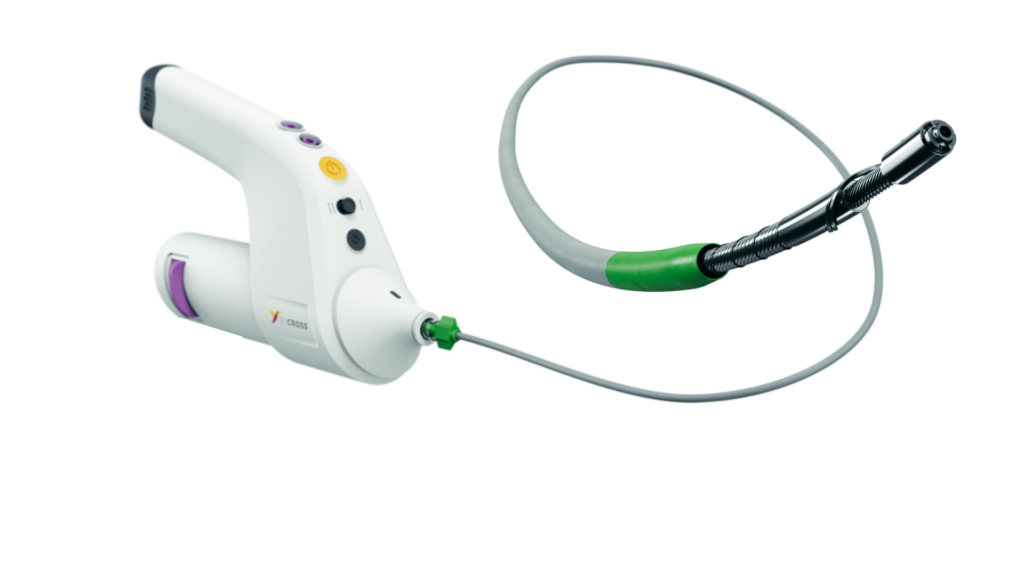
Mr Vijaynagar, who has worked at UHL for 13 years, said: “The real advantage of this technique is that we can treat a complex blockage through minimally invasive keyhole surgery. The device is particularly clever because it breaks down the material causing the blockage while simultaneously removing the debris, allowing us to restore blood flow and leave a much clearer stent.
“For the patient, avoiding major open surgery can mean less risk, a much quicker recovery and, in suitable cases, the possibility of returning home the same day.
“It has taken a great deal of work and collaboration across the team to bring this technology to UHL, so achieving such a positive outcome is hugely rewarding. Most importantly, Teresa has done incredibly well and is already seeing the difference the procedure has made.
“These innovations and advancements in the treatment of patients with Peripheral Artery Disease (PAD) would not be possible without the unwavering support and encouragement of my colleagues.
“I am incredibly grateful to our vascular department for fostering an environment that embraces innovation, truly establishing this as one of the most advanced vascular units in the country. We are incredibly proud to be the first hospital in the UK to use this technology in this way.”
The achievement is the latest example of pioneering vascular surgery taking place at UHL. Last year, Mr Vijaynagar led a team on a European-first surgery that used two resorbable (dissolving) scaffolds to restore blood flow to a patient’s foot.
Teresa is now continuing her recovery at home and hopes that being able to walk more comfortably will allow her to return to the activities she has missed over the last two years.
She added: “I just want to say thank you to everyone who has looked after me. I feel incredibly lucky to have been given this opportunity and I’m excited to get my life back.”