
View our current innovation projects, showcasing high-impact initiatives that improve patient care, enhance clinical education and accelerate digital transformation across healthcare. Each project is supported to scale impact and deliver meaningful, real-world benefits across the region.
Health Innovation Hub impact
Explore the impact of the Health Innovation Hub across Leicestershire, Northamptonshire and the wider region, supporting innovators to develop, adopt and scale innovations that improve patient care, staff experience and operational efficiency.

I-IMPACT is an award-winning online self-management programme designed to support people living with long-term cardiac, respiratory and Covid-related conditions. The programme helps users manage symptoms, improve quality of life and reduce the impact of long-term conditions through personalised rehabilitation, education and behavioural support.
Developed by rehabilitation specialists, clinical experts and patients, the programme is designed to be clinically robust and user-centred. It builds on over 10 years of experience from the University Hospitals of Leicester Pulmonary and Cardiac Rehabilitation teams, who developed successful digital programmes including Activate Your Heart, SPACE for COPD and Your Covid Recovery. Evidence from these programmes shows improvements in patient knowledge, exercise performance and overall wellbeing.
I-IMPACT is accessible across mobile phones, tablets and desktop devices, ensuring flexible and inclusive access for patients.
Key features
- Exercise and rehabilitation – Personalised exercise programmes following clinical assessment with activity goals and progress tracking.
- Symptom tracking – Tools to monitor symptoms and understand changes in condition.
- Educational resources – Guidance on condition management, medications and healthy lifestyle.
- Goals and motivation – Goal-setting tools to support behaviour change and engagement.
- Clinical support – Messaging feature enabling users to contact their rehabilitation team for advice and reassurance.
Supporting scale and growth
The ambition for I-IMPACT is to scale from a successful local programme into a regionally and nationally adopted digital rehabilitation pathway for long-term condition management across the NHS.
The Health Innovation Hub is supporting this scale-up by working with clinical, academic and industry partners to strengthen the clinical, regulatory and commercial foundations required for growth. This includes supporting clinical evaluation, regulatory readiness, MHRA compliance, commercial development, funding opportunities and wider NHS partnerships.
For more information visit the I-IMPACT website:
https://www.i-impact.co.uk/

Smart Scalpel UK is an award-winning surgical education innovation led by University Hospitals of Leicester NHS Trust designed to enhance surgical training through ethically governed, simulation-based video learning. The project uses anonymised surgical footage with informed patient consent, dual-surgeon commentary and clearly defined learning objectives to bridge the gap between real-world operative experience and trainee education.
Since August 2024, Smart Scalpel UK has produced 10 high-quality training videos supported by a structured feedback framework that enables continuous improvement, reflective learning and portfolio development for trainees.
Feedback demonstrates 100% perceived usefulness and 90% reported influence on clinical practice highlighting impact on confidence, competence and patient safety.
The innovation has received national and international recognition including First Place at the Midlands Simulations Conference (2025), the Innovation in Education Award at the UHL Educator Awards (2025) and international showcasing at FIGO 2025.
Supporting scale and growth
The Health Innovation Hub is supporting Smart Scalpel UK in scaling from a successful local innovation into a wider regional, national and international education platform. Working alongside clinical teams and strategic partners, the Hub is providing hands-on support across funding, branding, communications, engagement and commercial development.
Current support includes:
- supporting brand development, launch planning and content strategy to strengthen visibility and adoption
- creating a structured communications and engagement plan to reach clinicians, trainees, partners and national stakeholders
- developing digital content, case studies and impact storytelling to build credibility and awareness
- supporting early-stage funding applications and investment opportunities
- connecting regional, academic, NHS and industry partners to enable scale
- supporting commercial strategy development, licensing pathways and sustainability planning
- coordinating stakeholder engagement and relationship-building to accelerate uptake
- working alongside partners to shape a scalable delivery model that enables wider rollout

Oxford Medical Simulation (OMS) is a global leader in virtual reality (VR) medical education, delivering immersive, scenario-based training that helps clinicians practise complex clinical situations in a safe, realistic environment. OMS VR enables junior doctors and clinical teams to develop decision-making, communication, leadership and clinical confidence by simulating high-pressure scenarios such as acutely unwell patients, cardiac emergencies and escalation of care without risk to real patients.
Research shows that VR-based simulation improves clinical confidence, knowledge retention, and decision-making under pressure and patient safety outcomes. Immersive training has also been shown to increase learner engagement, accelerate skills acquisition and offer a scalable, cost-effective alternative to traditional simulation training.

Innovation background and relaunch journey
OMS VR was previously launched within the organisation as an innovation to support junior doctor training and received strong early feedback. However, delivery was paused due to funding constraints, limiting its ability to scale and embed long-term.
Recognising the value and impact of the programme, the Health Innovation Hub stepped in to support funding recovery and prelaunch. The Hub has helped secure funding and is now working in close partnership with Oxford Medical Simulation and clinical education teams to launch in the coming months and expand VR training across the organisation.
Supporting scale and growth
The Health Innovation Hub is actively supporting the relaunch, expansion and scalability of OMS VR by:
Securing and coordinating funding to restart and sustain delivery
Working in partnership with Oxford Medical Simulation to increase outreach and scalability
Supporting programme planning, rollout, and operational delivery
Supporting communications, awareness, and engagement campaigns to drive uptake
Capturing impact data, feedback, and evaluation outcomes to support future scale
Developing a sustainable and scalable delivery model for long-term regional expansion
Future ambition
The ambition is to scale OMS VR from a junior doctor training programme into a trust-wide immersive training platform for clinical staff in the long term supporting multidisciplinary workforce development, patient safety and system resilience. The Health Innovation Hub aims to embed VR simulation as a core component of modern clinical education, with future potential to expand across specialties, partner organisations, and the wider region.
Visit the Oxford Medical Simulation website for more information.
What the innovation is
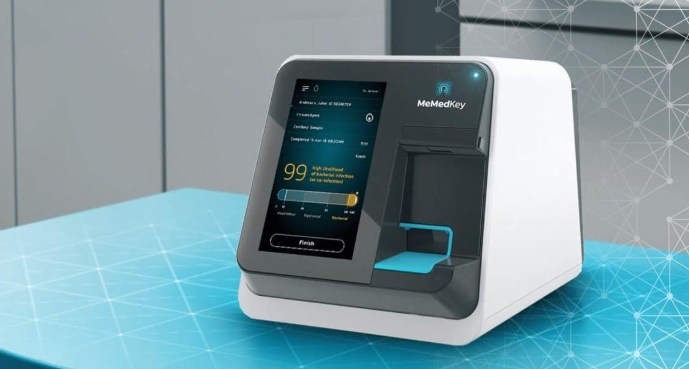
MeMed BV is an innovative point-of-care blood test that helps clinicians rapidly distinguish between bacterial and viral respiratory infections. The test supports faster and more informed clinical decision-making, helping ensure patients receive the most appropriate treatment and care pathway.
The innovation was introduced within the Same Day Emergency Care (SDEC) service at Glenfield Hospital following successful evaluation work delivered in partnership with Health Innovation East Midlands during winter 2024/25.
Delivered collaboratively with the Specialist Pneumonia Intervention Nurse (SPIN) team, Glenfield SDEC and the Point-of-Care Testing team, MeMed BV supports earlier diagnosis and more targeted treatment decisions for patients presenting with respiratory symptoms.
Key benefits
- Faster diagnosis – Supports rapid identification of bacterial and viral infections at the point of care.
- Improved patient flow – Enables earlier clinical decision-making, helping patients receive the right care sooner.
- Reduced avoidable admissions – Supports safe management of appropriate patients at home and helps reduce pressure on hospital capacity.
- Antimicrobial stewardship – Promotes more targeted antibiotic prescribing and supports efforts to reduce antimicrobial resistance.
- Enhanced patient experience – Reduces uncertainty and supports timely access to appropriate treatment.
- Supporting sustainability and future implementation
Following successful initial deployment, work is ongoing to explore opportunities to support the continued use of MeMed BV within the service and evaluate opportunities for wider implementation across UHL.
The Health Innovation Hub is supporting this work by bringing together clinical, operational and external partners to explore sustainable funding models, service benefits and future scalability.
How the Health Innovation Hub is supporting the project
The Health Innovation Hub is supporting the project through:
- Exploring funding opportunities to support continued deployment.
- Supporting evaluation and impact measurement.
- Working with clinical, operational and procurement teams.
- Identifying opportunities to improve patient flow and operational efficiency.
- Supporting antimicrobial stewardship initiatives.
- Exploring opportunities to maximise value from testing kits and consumables.
- Facilitating collaboration with Health Innovation East Midlands and external partners.
- Supporting future scaling opportunities across UHL.
This project reflects the wider ambition of the Health Innovation Hub to support the adoption and scale-up of innovations that improve patient outcomes, enhance staff experience and deliver more efficient healthcare services.

What the innovation is
Little Journey is a digital platform designed to help children and families feel more prepared, informed and confident before attending hospital appointments and procedures.
Developed by healthcare professionals, researchers and families, the platform provides age-appropriate information through virtual hospital tours, procedure explanations, relaxation activities and practical guidance. The aim is to reduce anxiety, improve patient experience and help families better understand what to expect throughout their healthcare journey.
The platform supports children and young people before, during and after hospital visits, helping create a more positive and reassuring experience for both patients and their families.
Key features
- Virtual hospital tours – Helping children become familiar with hospital environments before attending.
- Procedure preparation – Simple explanations and educational content to support understanding of treatments and procedures.
- Relaxation activities – Interactive tools designed to reduce anxiety and support emotional wellbeing.
- Family support resources – Practical guidance and information for parents and carers.
- Digital engagement – Accessible support available before, during and after appointments.
Supporting evaluation and future growth
The ambition for Little Journey is to improve the experience of children and families across a range of patient pathways while supporting services to reduce avoidable cancellations, improve preparation and enhance patient engagement.
Evidence from other healthcare organisations has demonstrated improvements in patient experience, reductions in anxiety and potential operational benefits through reduced cancellations and improved pathway efficiency.
The Health Innovation Hub is supporting evaluation and adoption activity across UHL to better understand the benefits for patients, families and services, while exploring opportunities for future sustainability and wider implementation.
How the Health Innovation Hub is supporting the project
The Health Innovation Hub is supporting the project through:
- Increasing awareness and adoption across UHL services.
- Supporting engagement with clinical teams and stakeholders.
- Delivering workshops and service engagement activity.
- Supporting communications and promotional activity.
- Coordinating data collection and evaluation.
- Assessing patient, workforce and operational benefits.
- Exploring future funding opportunities.
- Supporting long-term sustainability planning.
- Identifying opportunities for wider implementation across UHL.
This project reflects the wider ambition of the Health Innovation Hub to support innovations that improve patient experience, enhance staff engagement and deliver measurable benefits across healthcare services