
Cookie settings

We use some essential cookies to make this website work.

We’d like to set additional cookies to understand how you use uhleicester.nhs.uk, remember your settings and improve our services.

We also use cookies set by other sites to help us deliver content from their services.

View cookies
You have accepted additional cookies. You can change your cookie settings at any time.
You have rejected additional cookies. You can change your cookie settings at any time.
Skip to main content
University Hospitals of Leicester NHS Trust logo
  • About us
  • News
  • Patient resources
  • Careers
  • Contact
  • Our charity
  • Hospitals
  • Patients and visitors
  • Services A to Z
  • Research and innovation
  • Hospitals
  • Patients and visitors
  • Services A to Z
  • Research and innovation
  • About us
  • News
  • Patient resources
  • Careers
  • Contact
  • Our charity
  1. Home
  2. Services A to Z
  3. Neonatal Services
  4. Information for families

Our hospital, unit and team

Information including how to get to the hospital, parking, visiting times and contact details are available for both the Leicester Royal Infirmary and the Leicester General Hospital.

Take a tour of our neonatal unit at the Leicester Royal Infirmary.
Take a tour of our neonatal unit at the Leicester General Hospital.

As parents you will have 24-hour access to be with your baby. There is open access for siblings to visit, and other visitors between 2 pm and 8pm. Leicester Royal Infirmary has 3 double en-suite bedrooms and some extra bedrooms are available within the maternity hospital. At the Leicester General we have 2 bedrooms for families to room-in with their babies prior to discharge.

Rooming in: When preparing for discharge, you may be offered a bedroom to enable you to stay with your baby overnight, providing care and to establish feeding.

You will continue to have support from the nursing staff and other professionals whilst rooming in, as needed.

These rooms are limited and reviewed on a day-to-day basis.

Hand Hygiene

Babies with immature immune systems, are more vulnerable to infections—especially in hospital settings where there may be invasive procedures, antibiotic use, and exposure to harmful bacteria.

Good hand hygiene and standard infection-prevention practices greatly reduce these risks. Staff will help guide parents, but key steps include:

  • Washing hands when entering and leaving the unit
  • Storing coats and belongings in the designated areas
  • Washing hands before and after touching your baby
  • Washing hands before and after nappy changes, and disposing of nappies properly
  • Washing hands before and after preparing food
  • Washing hands before and after using your phone

    Consistent hand hygiene helps keep your baby safe.

Parent-Led Ward Rounds on NNU

We believe that you, as parents, play a vital role in your baby’s care. Parent-led ward rounds are a way for you to be fully involved in your baby’s treatment and progress while working alongside our medical team. They allow you to join the medical team during daily or weekly rounds to discuss your baby’s health and care plan, and any other updates. It is an opportunity for you to be actively involved and informed every step of the way. Our team is here to support you, and we want to make sure that you feel empowered and reassured during your time in the Neonatal Unit.

During these rounds, you will have the opportunity to:

  • ask questions
  • share any concerns or observations
  • receive information about your baby’s progress
  • be involved in making decisions about your baby’s care

Parent-Led Ward Rounds are important, as they:

  • Empower you as parents: Being involved in the decision-making process ensures that you are an active part of your baby’s care.
  • Improve communication: Directly communicating with doctors, nurses, and specialists ensures you receive clear and consistent updates about your baby’s condition.
  • Offer support for your emotional well-being: Knowing what’s happening with your baby’s care can provide reassurance and help you feel more connected to your baby’s treatment plan.
  • Personalised care: Your insights about your baby’s needs are valuable, helping the team to provide care that aligns with your family’s preferences and values.

What you can expect during the ward round

The team will listen to your feedback and make sure your family’s preferences are considered in your baby’s care plan.

Your baby’s medical team, including doctors, nurses, and AHP’s, will discuss your baby’s current treatment and progress.

You’ll be encouraged to ask any questions or voice concerns.

You’ll receive clear updates about your baby’s next steps, treatment, and care plan.

Security baby tags on the Neonatal Unit

To help keep your baby safe, our neonatal unit uses a secure electronic tagging system. Every baby receives a security tag shortly after admission.

How the Security Tag Works

  • The tag is gently attached to your baby’s ankle.
  • It is linked to our unit’s security system and activates automatically.
  • If the tag is removed without authorisation or taken near an exit, an alarm will sound and doors will lock automatically.

Why we use security tags

  • To prevent unauthorised removal of infants from the unit
  • To ensure your baby’s location is always safe and monitored
  • To give parents peace of mind during their baby’s stay

What parents should know

  • Please avoid trying to remove or adjust the tag, staff will do this when needed.
  • Let a nurse know right away if the tag seems loose or falls off, or is irritating your baby.
  • Only approved individuals will be allowed to move or hold your baby outside the unit.
  • The security tag is removed by staff when your baby is discharged.

Badger Note Diaries: A precious keepsake of your baby’s journey

Badger Notes Diaries offer a special way to capture your baby’s journey using photos and blog-style entries. It creates a lasting keepsake that you and your family can treasure forever.

The diary is hosted on a secure platform, accessible via a mobile app. You can log in using a password, and once set up, you can link family and friends so they can follow your baby’s progress too.

Our Play Specialists, Nurses and Nursery Nurses will keep your diary updated regularly.

Translation services on the Neonatal Unit

We want every parent to feel informed and supported. If English is not your first language, our neonatal unit offers translation and interpreting services to help you understand your baby’s care.

How we can support you:

  • Professional interpreters are available for most languages. Please inform staff of the language that you would like to be spoken to in, and if you would like an interpreter. You can let us know your preferred language at any time during your baby’s stay.
  • We will arrange support as quickly as possible to ensure you understand all discussions about your baby’s treatment and care. We can arrange in-person, telephone, or video interpreting depending on your needs and availability, such as time of day.

Our commitment

We are committed to making sure every family receives clear, safe, and respectful communication no matter what language you speak.

Parent Room: We have a parent room where parents can go to prepare and eat food and drink. This room has a fridge, kettle, microwave and some basic supplies.  

You are welcome to express your milk at your baby’s bedside on the unit, with the use of privacy screens. Please ask staff to support you with these, as well as pillows and foot stools to make yourself comfortable.  

Milk Kitchen: We also have a dedicated room to support expressing and breast feeding, with screens, breast pumps and comfortable chairs.  

You can store and prepare expressed breast milk for your baby here too. The area has a fridge, a freezer, and cleaning equipment. We can only store 1 box of breast milk for each baby, so please take excess home to store safely in your freezer. Remember to check the freezer for milk before you are discharged home too. 

Quiet rooms: There may be times that you wish to speak to a member of the medical or nursing team privately. We have several spaces on the unit that team members can take you to for private and confidential conversations. 

Parking is free for you if your baby is an inpatient on the neonatal unit. 

A form will be given to you on admission and needs to be re-signed every 17 days. Please take note of when it is next due to be revalidated and ask staff for another form. Our car parks operate on Automatic Number Plate Recognition (ANPR) and only one car can be nominated. 

Whilst your baby is an inpatient on the neonatal unit we are able to offer you: 

  • Breakfast: There is a selection of breakfast cereals and bread available in the parents lounge. 
  • Lunch: A snack box can be ordered – this consists of a sandwich, crisps, a piece of fruit and a drink. This needs to be ordered by 10am. 
  • Dinner: A variety of hot meals can be ordered which will be served in the parents lounge. This will need to be ordered by 1pm.  

Please let us know if you have any dietary requirements or allergies. 

Medical 

Our medical team includes Consultants, Trust appointed specialty doctors and Clinical fellows.  Our service supports resident paediatric/neonatal specialist doctors in training through the East Midlands Deanery. We have close links with the University Hospitals Leicester Medical School, providing clinical training for phase 2 students, and support Foundation year trainees. Advanced Neonatal Nurse Practitioners support the medical and nursing rota. 

Nursing 

Three matrons, a lead nurse and head of nursing support our service. Our nursing team comprises Bands 3 to 7 and are supported by two ward managers and an education team.  

We have an established Home care team led by fourth matron, and an education team. Our home care team provides an outreach service including enhanced transitional care for late preterm babies born small, nasogastric tube feeding, home phototherapy and home oxygen therapy. 

Allied services 

Our play therapists, specialist feeding advisors, psychologist, occupational therapist, physiotherapist, speech and language therapists, dietician, receptionists, housekeepers, clinic coordinators, secretarial staff support the clinical service. We have a strong public health component to our service, around reducing risks for perinatal and infant mortality led through the STORK team. Our bereavement team includes Rainbows palliative care nursing support. 

Physiotherapy and Occupational Therapy
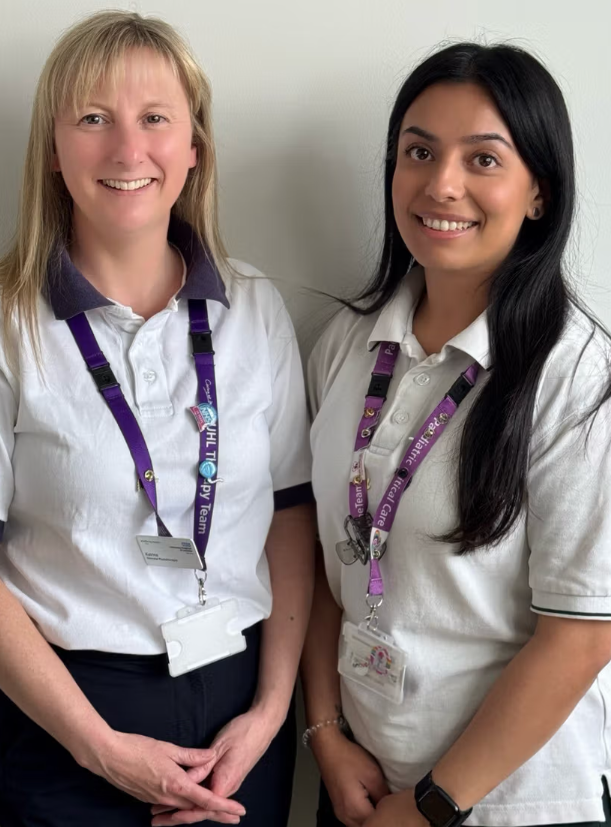
Neonatal Occupational Therapy and Physiotherapy, are part of the multidisciplinary team supporting your baby’s development in the Neonatal Unit. We work closely together to provide early assessment, individualized support, and family education from admission through to discharge. Together, we focus on helping your baby grow, move, and thrive in a developmentally appropriate and nurturing environment.

How we support you and your baby:

1. Promoting bonding and family involvement

  • Support skin-to-skin care (kangaroo care) and positive touch to strengthen the parent-baby bond.
  • Help you understand and respond to your baby’s cues.
  • Empower families to confidently care for their baby both in the unit and at home.

2. Assessing movement and development

  • Monitor muscle tone, reflexes, posture, and motor skills.
  • Observe your baby’s sensory responses (to touch, light, sound, and movement).
  • Identify how your baby self-regulates and adapts to their environment.
  • Screen for any signs of developmental delay or neurological concerns.

3. Promoting safe handling and positioning

  • Provide guidance on handling techniques that protect and support your baby’s development.
  • Use specialised positioning aids to encourage comfort, safety, and normal movement patterns.

4. Encouraging early movement and sensory input

  • Use gentle positioning and sensory stimulation to promote healthy motor and sensory development.
  • Offer age-appropriate sensory experiences aligned with your baby’s stage of development.

5. Educating and supporting families

  • Teach you how to support your baby’s neurodevelopment through daily care routines.
  • Provide guidance on positioning, handling, and interaction techniques.
  • Work closely with the wider neonatal team, including doctors, nurses, speech therapists, and lactation consultants, to offer holistic care.

6. Facilitating neurodevelopment

  • Encourage early skills such as self-regulation, eye tracking, head control, and age-appropriate movement.
  • Promote healthy development patterns to reduce the risk of long-term delays or complications.

7. Optimizing the environment

  • Help create a calm, developmentally supportive NICU environment.
  • Advise on adjusting lighting, noise, and stimulation to meet your baby’s needs.

As your baby grows, we will continue to support with developmental play ideas and home strategies tailored to their individual needs and age.

Share this page

Give feedback about this page

In this section

  • Our hospital, unit and team
  • My role in caring for my baby on the unit 
  • Understanding unit transfers 
  • We are compassionate
  • We are proud
  • We are inclusive
  • We are one team
University Hospitals of Leicester NHS Trust logo

Follow us

Translate

  • Contact
  • Accessibility
  • Privacy
  • Cookies
  • Terms and conditions
  • Freedom of information
  • Website feedback form

Copyright © 2026 University Hospitals of Leicester NHS Trust

Lovingly crafted by Mixd